
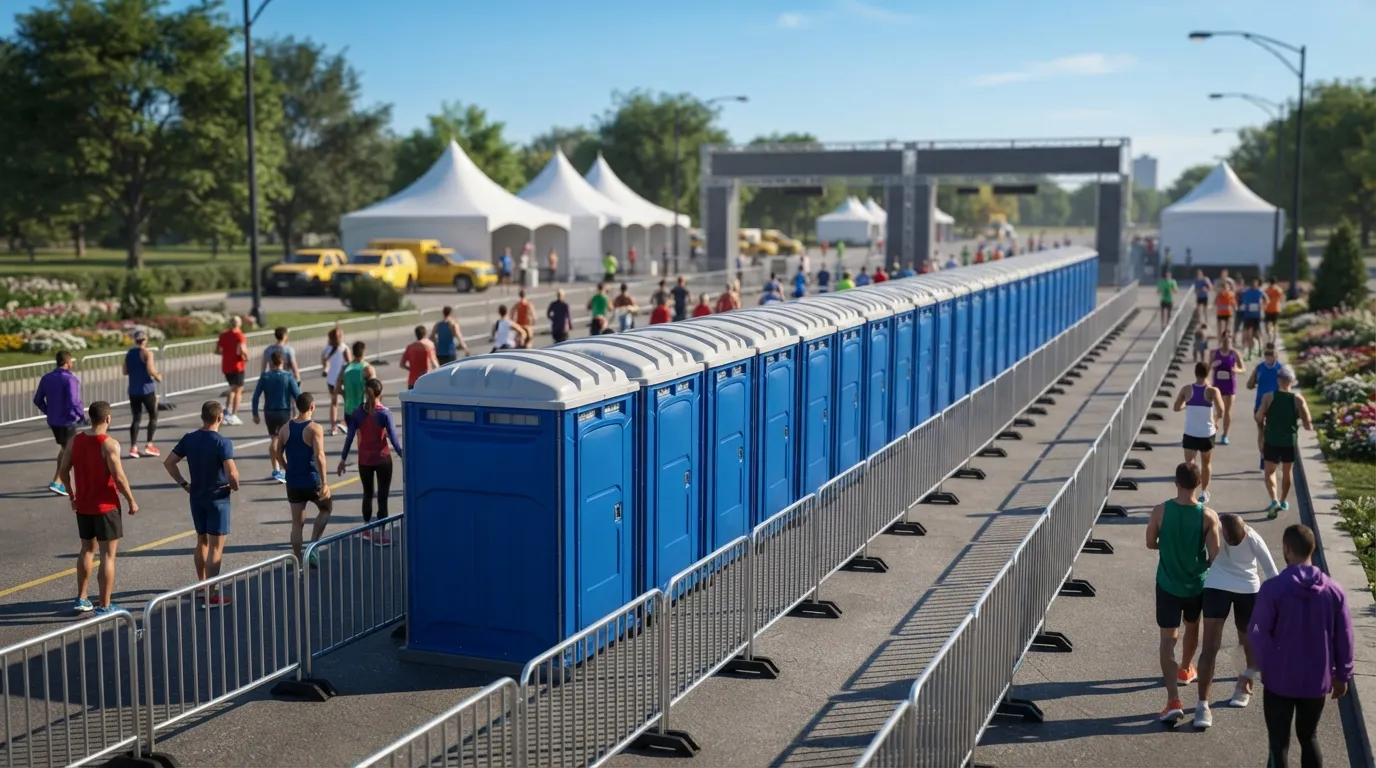
How many restrooms does a marathon need?
Start with the runner count, then add spectators and volunteers separately, because they cluster at different points on the course. A 500-runner race in Georgetown usually calls for a mix of standard porta potty rental units at mile markers and a denser cluster near the start/finish. ANSI/PSAI Z4.3 sets one service visit per week for up to 10 users over a 40-hour week as its baseline interval, which is why race organizers lean toward extra units instead of extra servicing on event day. Every cluster needs at least one accessible unit under ADA Standards section 213.2, which requires 5 percent of a clustered group, and never fewer than one. If your course runs near Serenada, 5.1 miles north of Georgetown, or loops toward Santa Rita Ranch, 13.6 miles west, factor drive time into your delivery window so units land before packet pickup. Aid stations at mile 6, 13 and 20 typically get two standard porta potty rental units each, spaced apart so lines do not block the course. For a finish-line festival feel, some races add a deluxe flushable porta potty or two near VIP and sponsor tents. Check the porta potty placement guide before you finalize your map, since surface stability and route clearance both affect where a unit can actually sit.
What does it cost to rent restrooms for a race?
Race-day pricing runs by the unit and the day, not a flat headcount fee, and most organizers rent for the event day plus a setup day before.
| unit | duration | typical price |
|---|---|---|
| standard | event | $400 |
| standard | day | $150 |
| ada | day | $230 |
| deluxe | day | $300 |
| service_fee | day | $175 |
A standard unit rented for a single event day generally runs in the $200 to $800 event-rate band, and pricing on our porta potty rental cost page breaks this down further by unit type. If your race also needs a command trailer or media area, a restroom trailer rental or a mobile office trailer rental can serve as a staff hub. Multi-day festivals attached to a race weekend sometimes do better with monthly porta potty rental terms if the course infrastructure stays up for a week or more. Ask about the delivery fee separately, since it is billed apart from the unit itself and depends on how far the route sits from Georgetown proper.
Should we run generators or a temporary power pole for race timing?
Timing mats, PA systems and finish-line lighting all draw power, and most races either run a generator or request a temporary power pole from the utility if the event returns to the same site each year. If you go with a power pole, here is how to brace a temporary power pole for race weekend: set the pole plumb in a stable footing, guy it at the top with wire rated for the load, and keep the guy angle wide enough that wind and cable tension do not walk the pole out of vertical over the event weekend. A loose or unbraced pole is a hazard around a crowd, and OSHA's ground fault protection requirement under 1926.404(b)(1)(ii) still applies to any temporary circuit you run off it. Pair your power setup with a light tower rental if your race starts before sunrise, which is common for Texas summer events trying to beat the heat. Keep barricades along the course consistent with ANSI D6.1 under OSHA 1926.202 if you are also managing vehicle traffic near runners. For crowd lanes at the start corral, a crowd control barrier rental keeps runners funneled without needing staff at every gap, and a short run of chain link temporary fence around the finish-line festival area keeps foot traffic out of team-only zones. If the race benefits a local cause and draws a big crowd, treat it like the county fair restrooms or festival restroom rental pages describe, since the logistics overlap closely.
How far in advance should we book race restrooms?
Book four to six weeks ahead for a race over 300 runners, since delivery trucks need routing time and popular fall race weekends in Georgetown fill fast. Smaller races can often book two to three weeks out. Confirm your final headcount a week before delivery so the unit count matches actual registration.
Do we need an ADA unit even for a small 5k?
Yes. ADA Standards section 213.2 requires at least one accessible unit anywhere units are clustered, regardless of total race size. A single ADA accessible porta potty near the start/finish line satisfies most small race layouts.
Can restrooms be moved along the course after setup?
Not easily once runners are on course. Units get placed before the race starts and stay put until after cleanup, so plan your mile-marker locations carefully during route mapping rather than expecting mid-race repositioning.
What happens if our race route crosses into Hutto or another nearby town?
Tell us the full route. Hutto sits 16.5 miles southeast of Georgetown, and Liberty Hill is 16.3 miles west, so a course crossing city lines may need coordination on delivery timing. Check our service areas page for coverage details.
How do we handle handwashing at aid stations?
Pair each restroom cluster with a handwashing station rental, since 29 CFR 1910.141(d)(2) requires soap and towels or a hand-drying device, not sanitizer alone, everywhere volunteers handle food or medical supplies at aid stations.
Next step
Get a delivery date
Tell us the address, the dates and the headcount. We size the order and confirm the route.